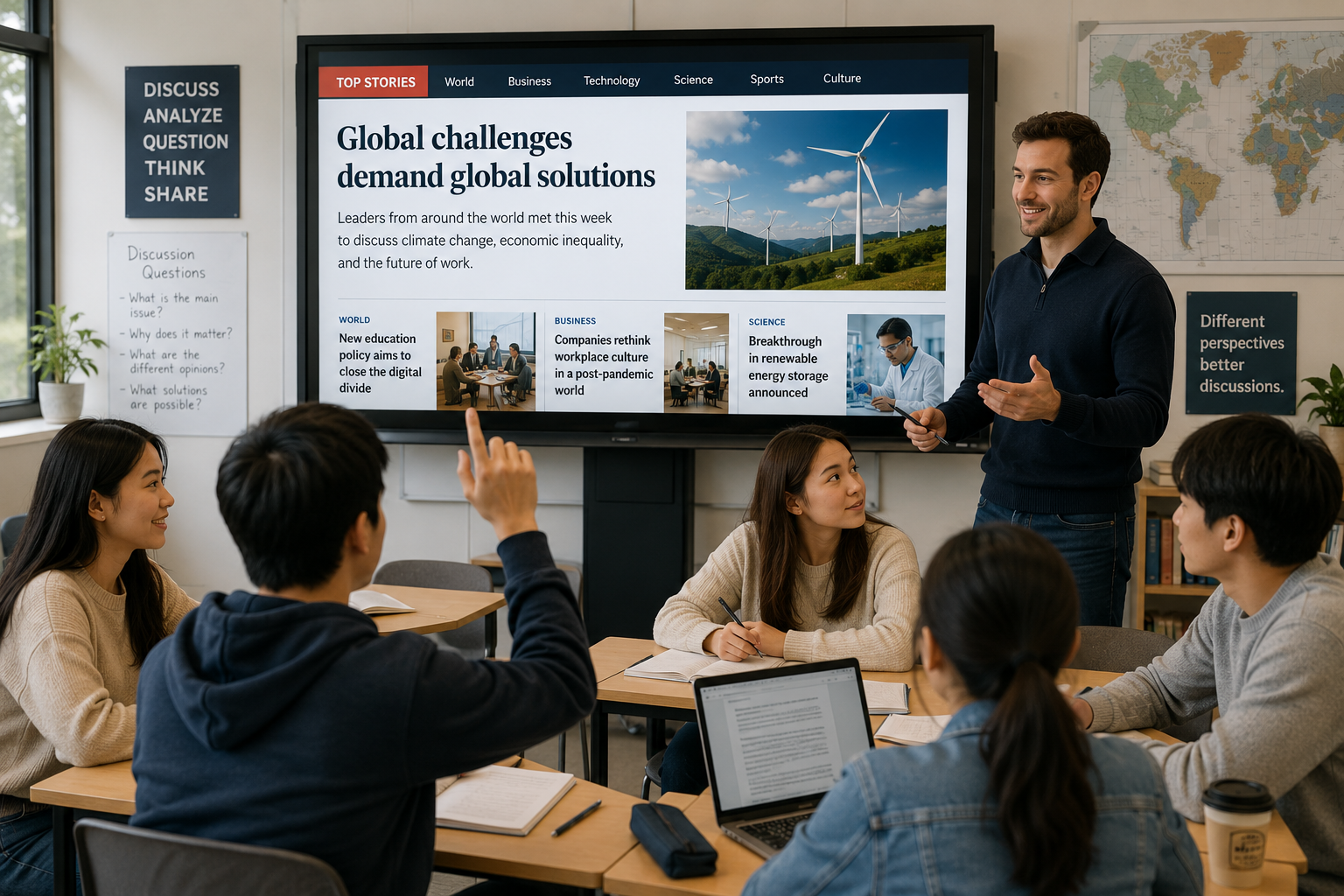
News articles can be some of the most valuable materials in an ESL classroom. They connect English with the real world, expose students to modern vocabulary, and introduce issues that naturally encourage conversation.
However, bringing a newspaper article into class does not automatically create a successful lesson. Many news-based activities become long reading exercises followed by a few comprehension questions. Students may understand the story, but they are given little reason to discuss it.
The real value of a news article is not simply the information it contains. It is the questions, choices, and competing perspectives that the story makes possible.
The following approach is designed particularly for B1–B2 university and adult learners. It can also be adapted for stronger high school classes or advanced students who need more challenging media analysis.
Why use news articles in ESL?
News gives students a clear connection between classroom English and the world outside it. Instead of discussing fictional situations, learners use English to understand events, explain opinions, and respond to issues that affect real people.
News-based lessons can develop several skills at the same time. Students read for meaning, learn vocabulary in context, summarize information, listen to classmates, and defend their own ideas.
They also provide an excellent foundation for critical thinking. Most worthwhile stories involve disagreement, uncertainty, or a difficult decision. Students are not simply searching for a correct answer. They are deciding what they believe and explaining why.
The central principle
The article should provide the shared information, but the discussion should be the heart of the lesson.
Choose the right news story
Not every important story will work well in an English class. A topic may be interesting to the teacher but require too much specialist knowledge, political background, or difficult vocabulary for students to discuss confidently.
The strongest classroom stories usually share three qualities.
1. The basic situation is easy to understand
Students should be able to grasp the central issue without listening to a twenty-minute lecture first. Some background information may be necessary, but it should support the lesson rather than dominate it.
2. There is more than one reasonable viewpoint
Stories with an obvious moral answer often produce weak discussions. Better topics contain tension. A four-day workweek may improve well-being but create problems for businesses. Artificial intelligence may support learning but also make cheating easier. Tourism may create jobs while damaging local communities.
3. Students can connect the issue to their own lives
Technology, education, work, health, culture, media, sport, money, and the environment tend to work well because students already have experiences and opinions related to them.
Highly graphic stories, very local political disputes, and rapidly changing breaking news can be more difficult to handle. They are not always unsuitable, but they require careful framing and sensitivity to the students in the room.
Adapt the article without removing its meaning
Authentic news writing is often too long and linguistically dense for a classroom lesson. It may contain complex quotations, background details, institutional names, and references that are not essential to understanding the central issue.
Adapting the text does not mean making it childish. It means removing unnecessary difficulty while protecting the ideas that make the story worth discussing.
For a B1–B2 class, a text of approximately 250 to 350 words is often enough. This gives students a common foundation without using most of the lesson for silent reading.
Keep the people, choices, consequences, and disagreements that matter. Remove details that students do not need in order to form an opinion. Short paragraphs and clear transitions will also make the article easier to process.
Do not teach every unknown word
Select a small number of useful words that students may use again during the discussion. Five carefully chosen vocabulary items are usually more valuable than a list of twenty.
Build curiosity before reading
Many teachers distribute the article immediately and ask students to begin. A stronger approach is to create curiosity first.
Show students the headline, an image, or a surprising statistic. Ask what they think has happened, who may be affected, and what the central disagreement could be.
Prediction gives students a purpose for reading. They want to discover whether their first impressions were accurate.
Useful pre-reading questions
- What do you think this story is about?
- Why might this issue be in the news now?
- Who could benefit from this situation?
- Who might be negatively affected?
- What questions would you like the article to answer?
This stage should be short. Its purpose is not to explain the article in advance. It is to activate ideas, introduce essential language, and give students a reason to continue.
Give students a clear reading purpose
Avoid asking students simply to “read the article.” Give them a question or task that directs their attention.
On the first reading, students might identify the main problem and the people involved. On the second, they can look for the arguments, evidence, causes, or consequences.
Comprehension questions still have a place, but they should confirm understanding rather than consume the lesson. A small number of true-or-false statements or short-answer questions is usually enough.
Students can also compare answers with a partner before whole-class feedback. This gives them an additional opportunity to speak and resolve misunderstandings independently.
Turn the story into a real discussion
Factual questions help students understand what happened, but opinion questions help them use English. Once the article is clear, move from information to evaluation.
Questions such as “What happened?” and “Where did it happen?” have one correct answer. Questions such as “Was the decision fair?” or “Who should take responsibility?” require students to explain, justify, and respond to one another.
Discussion questions that work across many stories
- What is the most important issue in this story?
- Do you agree with the decision that was made?
- Who has the greatest responsibility?
- Who benefits, and who pays the price?
- Could the same situation happen in your country?
- What would you have done differently?
- What should happen next?
Give students a minute to prepare before they speak. Asking learners to form an opinion and write one supporting reason can dramatically improve the quality of a discussion. They no longer need to invent an idea and produce English at exactly the same moment.
Build critical thinking into the lesson
A discussion becomes more meaningful when students have a decision to make or a problem to solve. Instead of asking groups to “talk about the article,” give them a clear outcome.
They might rank possible solutions, design a policy, prepare advice for a decision-maker, or reach a group agreement. These activities create a reason to listen as well as speak.
Role-play is particularly effective with news stories because real issues usually involve different stakeholders. Students can speak as business owners, local residents, government officials, journalists, consumers, parents, or young workers.
Another useful activity is asking students to argue for a position they do not personally support. This encourages them to understand an opposing viewpoint rather than immediately dismiss it.
Move beyond “What do you think?”
Ask students to make a choice, defend it with evidence, answer a challenge, and respond to a different perspective.
Teach the media, not only the story
Students increasingly encounter news through social media, short videos, notifications, podcasts, and online personalities rather than traditional newspapers. A modern news lesson should therefore examine how information is presented as well as what happened.
Compare two headlines about the same event. Ask students which words create a positive or negative impression. Show two different images and discuss how each changes the emotional meaning of the story.
Students can also consider what information has been emphasized, what may be missing, and who produced the report. These questions help learners become more careful consumers of information without requiring them to believe that every news source is equally unreliable.
Media literacy questions
- Who created this report?
- Who is the intended audience?
- Which voices are included?
- Which perspectives may be missing?
- How does the headline influence the reader?
- What evidence is used to support the claims?
- Is this news, opinion, advertising, or a mixture?
Use more than written text
News is multimedia. A written article can be supported by a short audio report, photograph, video clip, chart, advertisement, social media post, or infographic.
Different forms of media also create useful comparison tasks. Students can decide which format communicates the story most clearly, which feels most trustworthy, and which has the strongest emotional effect.
Keep additional media short and purposeful. A two-minute clip that introduces a contrasting viewpoint is more useful than a long video that repeats everything students have already read.
Common mistakes to avoid
Choosing an article that is too difficult
Students should be challenged by the ideas, not defeated by every sentence. If the text requires constant translation, there will be little time or energy left for discussion.
Explaining too much before students begin
Background knowledge is useful, but long teacher explanations make students passive. Give them enough information to enter the topic, then allow the article and activities to do the work.
Focusing on grammar instead of meaning
A news article will contain many interesting grammatical structures, but stopping to analyze each one can destroy the momentum of the lesson. Language work should support communication rather than replace it.
Asking questions with obvious answers
“Is pollution bad?” will not create much disagreement. “Should consumers pay more for products that cause less environmental damage?” gives students a real choice with practical consequences.
Ending immediately after comprehension
Understanding the article is only the beginning. Students need time to interpret the story, connect it to their experiences, and decide what they think should happen.
A simple news lesson structure
A successful news-based class does not need to be complicated. The following structure can be adapted for a fifty-minute lesson or expanded across a longer class.
- Warm-up: Introduce the issue with an image, headline, question, or prediction task.
- Vocabulary: Pre-teach a small number of useful words that are central to the article.
- Reading: Give students a clear purpose and keep the text manageable.
- Comprehension: Confirm that students understand the main facts, arguments, and consequences.
- Discussion: Move from factual understanding to personal opinion and evaluation.
- Critical thinking: Ask students to solve a problem, rank options, debate, or make a group decision.
- Final speaking task: Give students a clear role, audience, and communication goal.
The precise balance will depend on your class, but reading should not take all the available time. A news article is most valuable when it becomes the beginning of a conversation rather than the end of a reading exercise.
Final thoughts
News articles are far more than convenient sources of reading practice. Used well, they help students understand different perspectives, question information, solve problems, and communicate with greater confidence.
The best news lesson is not necessarily based on the biggest headline of the week. It is based on a story that students can understand, connect with, and genuinely disagree about.
When students leave the classroom still discussing the issue, the article has achieved something much more valuable than another completed worksheet.
Ready-to-teach discussion lessons
Perspective English lessons combine original articles, vocabulary, comprehension, critical thinking, speaking activities, teacher guides, classroom presentations, and audio.
Explore all Perspective lessons →